

Platform
Institutional decisions deserve an institutional record.
LIBA SI works alongside existing investment analysis workflows, preserving the evidence, assumptions, recommendations, and approvals behind consequential real estate investment decisions.
Related product record
Inspect the original screenshot
Your deal lifecycle
Where the Decision Record fits.
01Sourcing and screening
Your tools todayDeal pipeline, CRM and data rooms
LIBA SI keepsEvidence attached to the decision it supports: rent rolls, T-12s, comparables.
02Underwriting
Your tools todaySpreadsheets and underwriting models
LIBA SI keepsAssumptions locked at approval, every version kept. AI advice recorded apart.
03Investment committee
Your tools todayMemos, decks and email threads
LIBA SI keepsA named approver, with conditions, overrides and their reasons.
04Asset management
Your tools todayProperty management and reporting
LIBA SI keepsActual results measured against the forecast recorded at approval.
The workflow
From underwriting to institutional memory.
01 — Establish the evidence
Preserve the sources supporting the investment case.
02 — Record the assumptions
Connect financial assumptions to the decision being evaluated.
03 — Review the risks
Keep AI recommendations and identified concerns available for review.
04 — Authorize the decision
Record the responsible decision-maker, approval conditions, and rationale.
05 — Compare the outcome
Connect subsequent results to the assumptions originally approved.
LIBA SI is not a replacement for every underwriting, accounting, or asset-management system. It provides a governed decision record connecting investment analysis, authorization, and outcomes.
The workflow, compared
From scattered workflow to one record.
Software computes. AI advises. Humans decide.
Software computes
Calculation
Deterministic, versioned calculations preserve the relationship between recorded inputs and financial outputs.
AI advises
AI analysis
AI-generated analysis can identify risks and questions for human review. Its recommendations remain distinguishable from authorized decisions.
Humans decide
Human approval
Authorized investment professionals retain responsibility for approvals, conditions, and overrides. Accepted, rejected and changed recommendations are recorded.
Model-agnostic, so the record keeps its value as AI models change. See what a record holds.
AI governance
How LIBA SI uses AI, and where people stay responsible.
Deterministic calculations
Underwriting runs on versioned calculation engines. The same recorded inputs always produce the same outputs, so a past approval can be re-checked. AI does not perform the financial calculations.
AI recommendations
A model reviews the analysis and returns a stance, its rationale, the evidence it cited and its concerns. The result is recorded as advice, apart from the calculations and the decision.
Model identification and versioning
Each recommendation is stored with the model provider, the model, the model version where the provider reports one, the version of the instructions it was given and a fingerprint of the context it saw. Recommendation records are append-only. LIBA SI can work with more than one model provider.
Human approval authority
Only a named Principal can approve a decision. When an AI recommendation disagrees or raises an adverse view, approval requires a written override reason, enforced by the database.
Model limitations
Models can be wrong, incomplete or inconsistent with each other. A recommendation is not a verified fact or a forecast of the outcome, and LIBA SI does not publish accuracy figures for AI recommendations.
Data processing and retention
To produce a recommendation, the relevant decision context is sent to the configured model provider. LIBA SI does not train models on firms’ private Decision Records. Recommendation records stay with the Decision Record; retention and deletion terms are set in each deployment agreement, and provider handling is covered in the security review.
Institutional decision history
The Decision Record accumulates history; the AI models do not retrain themselves on it. People review that history: outcomes are recorded against the forecast approved at the time, and similar past decisions, with their warnings, overrides and results, can be opened beside a new one.
Capabilities
Where these capabilities stand.
Each capability above is built and deployed at LIBA Capital, our first deployment, where production acceptance is still under way. No outside firm is a customer yet.
Audit history. Every change, approval and timestamp stays with the record instead of being overwritten. Review governance and security.
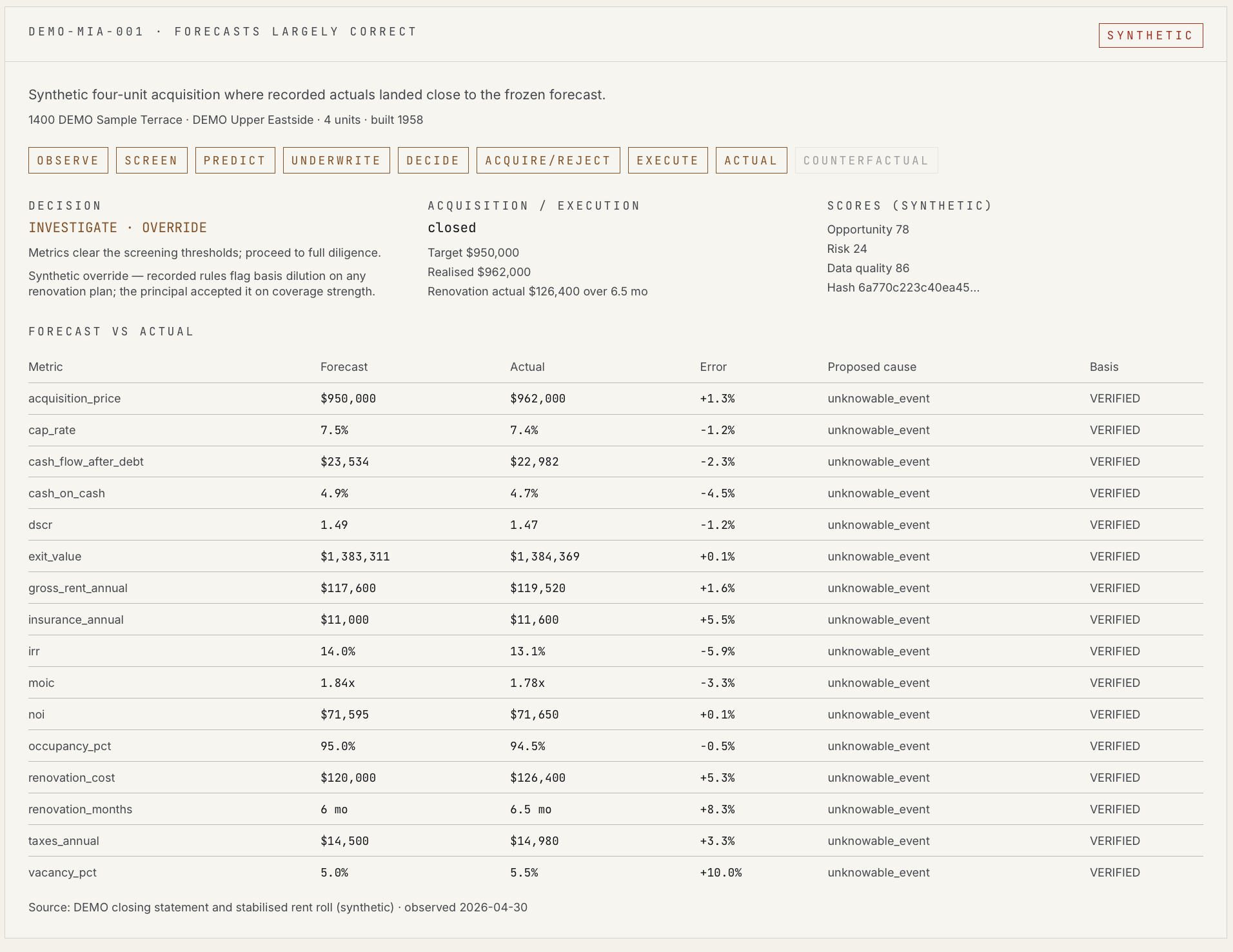
Outcome tracking and monitored assets. Actual rents, costs, timelines and lease-up compared with the forecast recorded at approval. A property under this tracking is a monitored asset, the unit plans are sized by.
Exports, API and integrations
Available: in the product today. Limited: available with the restriction shown. No release dates are given for anything not available.
A detailed technical maturity assessment is available to enterprise and investor due-diligence teams on request.
See these screens in a private walkthrough.
Pick a past acquisition, bought or passed. We walk through how LIBA SI would record its evidence, assumptions, approval and outcome, screen by screen.
Request a Private Demonstration